My article for JTA previewing Pope Francis’s visit to the Rome synagogue January 17.
By Ruth Ellen Gruber
January 15, 2016
(JTA)

My article for JTA previewing Pope Francis’s visit to the Rome synagogue January 17.
By Ruth Ellen Gruber
January 15, 2016
(JTA)


Banjo Romantika, the documentary about Czech bluegrass music in which I appear (as the main talking head) will be broadcast on public PBS television stations around the United States in December.
You can see the growing list of stations on the film’s web site — click HERE.
Broadcast venues include channels in New Mexico, Texas, Arizona, North Carolina, South Carolina, Illinois, Tennessee, California, Virginia, Kentucky….
I spent a few days earlier this month in Johnson City,TN, with the filmmakers — Lee Bidgood and Shara Lange. We recorded a commentary track for the film, which will be included in the new DVDs that are being prepared. We discussed the making of the film, but also the history

Me in front of the abandoned synagogue in Hostice, CZ
The New York Jewish Week runs a (rather blush-worthy!) article by travel writer Hilary Danailova about me and my Jewish heritage work, including the Jewish Heritage Europe web site.

Here’s my recent article for JTA on how commemoration and mass tourism collide at Auschwitz.
This is a crosspost from my SauerkrautCowboys blog

This was the third time I have been to the Equiblues rodeo and country music festival in St. Agreve, France — an annual event that draws upwards of 25,000 people and that this year was celebrating its 20th edition.
It was one of the first big country-western festivals I attended (back in 2004) when I first started following the “scene”. Last time I was there was 3 years ago — read what I wrote back then HERE and HERE.
Equiblues lasts the better part of a week, but this year, I only was able to make it there for Friday evening and Saturday, and — alas — I missed all of the rodeo — though I saw some of the cowboy mounted shooting competition.
One of my reasons for going was to meet with Georges Carrier, an expert on country music in France who had been the director of the Country Rendez-vous festival in Craponne for 18 years.
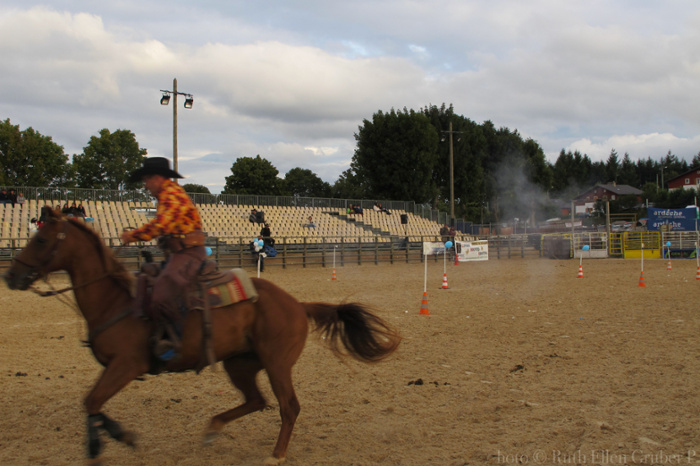
I parked in front of the scene in the photo at the top of this page — a fitting welcome image.
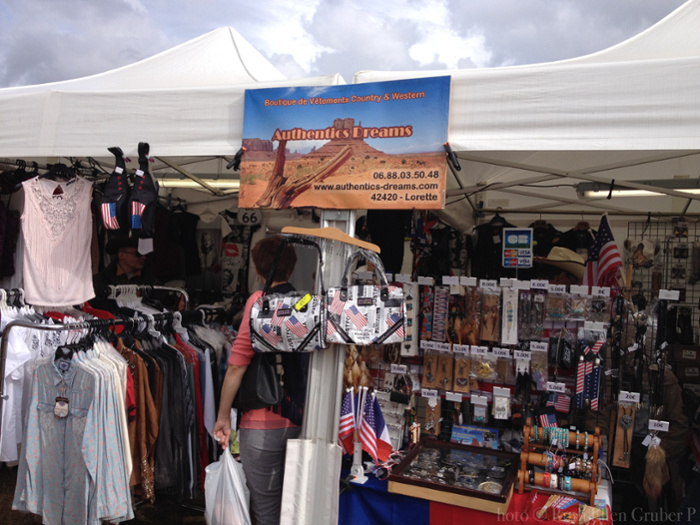
But the photo below encapsulates the atmosphere event better: “Authentic Dreams”. Festivals like Equiblues are signal embodiments of what I call “real imaginary” spaces — a re-created; no — a created — “America” where everyone wears cowboy hats and boots and hustles and bustles amid the trappings of the frontier; but where little has much really to do with the United States. As usual, except for some of the artists and rodeo performers, I was one of the only — if not the only — American there. I did hear English in the crowd from one couple strolling through, but UK English.

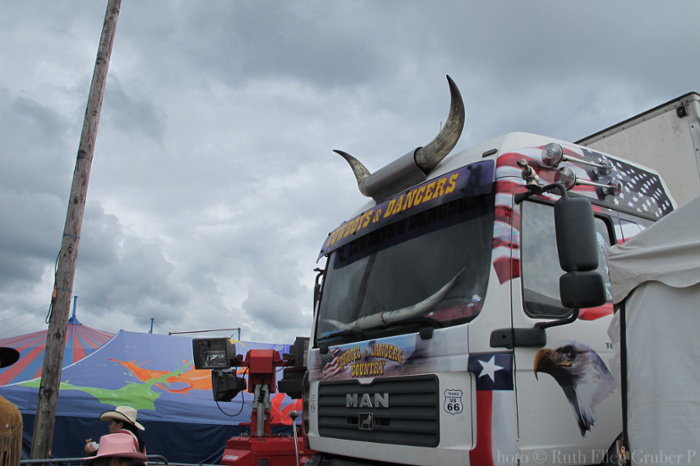
Actually, I found this year’s Equiblues just about identical with what I found three years ago. Even the same food (sausage and frites; steak and frites; wine; beer…) and physical set-up. For festival-run merch, tickets, food, and events — you have to pay in Equiblues dollars that you have to buy with Euros: one dollar = one Euro.
As usual, I was fascinated by the use of flag imagery — American flags, Confederate flags and various other flags and banners. They are used basically without much meaning, as decoration mean to provide an “American” or “Rebel” spin, as backdrops, clothing, ornamentation.
In the photo below, fly in a row, over a souvenir and clothing stand,
The Jewish Quarterly publishes my review of the book Memory Unearthed: The Lodz Ghetto Photographs of Henryk Ross
By Ruth Ellen Gruber
June 22, 2015
The extraordinary images reprinted
Share this:
Lee Bidgood has written an engaging essay in Ethnomusicology Review about collaborating with Shara Lange on the filming of Banjo Romantika, the documentary about Czech bluegrass music that I helped on and in which I appear as a “talking head.” He writes about the practical nuts-and-bolts of filming as well as his changing role as scholar and participant.
When Shara and I set out to film in the Czech Republic, my lingering sense of a scholarly ideal led me to impose a research-design structure to our slate of scheduled interviews and visits to performance events.
Share this:
 At the Country Rendez-vous festival, Craponne, France, 2008. Photo

Me outside the ruined synagogue in Kalvarija, Lithuania, the town from which by great-grandparents emigrated to the US around 1880
A long article on Jewish roots travel by Hilary Danailova in New York Jewish Week quotes me at length about changes in the Jewish heritage and Jewish heritage travel scene over the past quarter century.
The French actor Pierre Brice has died. Much of Europe is in mourning; few Americans have ever heard his name.
Brice, who was 86, starred as Winnetou, the Apache chief who was the hero of a series of movies shot in the 1960s based on the wild west stories of Karl May, the German hack writer who died in 1912 and never set foot in the American west but who thrilled the Old Continent with his tales.
I fell in love with Brice, like (almost) every other girl in central Europe, when as a teenager I spent the summer of 1966 in Prague and saw my first Winnetou movie. It was called “Old Shatterhand” and also starred the American actor Lex Barker as Winnetou’s blood brother, the German adventurer Charlie, AKA Old Shatterhand.
My then-10-year-old little brother and I went to see a 10 a.m. showing at the Sevastopol movie theatre in downtown Prague. After that I was obsessed. I bought a postcard of Brice in his Winnetou costume — darkened skin and long black locks held by a head band — and I cut out photos of him from Czech magazines.
As I wrote in an article about Karl May festivals more than a decade ago:
With his long hair and good looks, Brice set the mold for how a stage Winnetou should look and act, just as the late American actor Lex Barker, the original Old Shatterhand in the movies, set the standard for that role with his rugged features and trademark fringed buckskins.
I regret that I never got to interview Brice for my ongoing Imaginary Wild West project.
But Dana Weber and I did interview another Winnetou — Gojko Mitic, a Yugoslav-born actor who won fame during the Communist era playing Native Americans in East German-made Westerns, Mitic played Winnetou at the oldest and biggest summer Karl May festival, that in Bad Segeberg, Germany, where Brice himself had long been associated.

Gojko Mitic as Winnetou at the Bad Segeberg Karl May festival

Dana Weber, Gojko Mitic, and me at the Karl May festival in Radebeul, 2008
