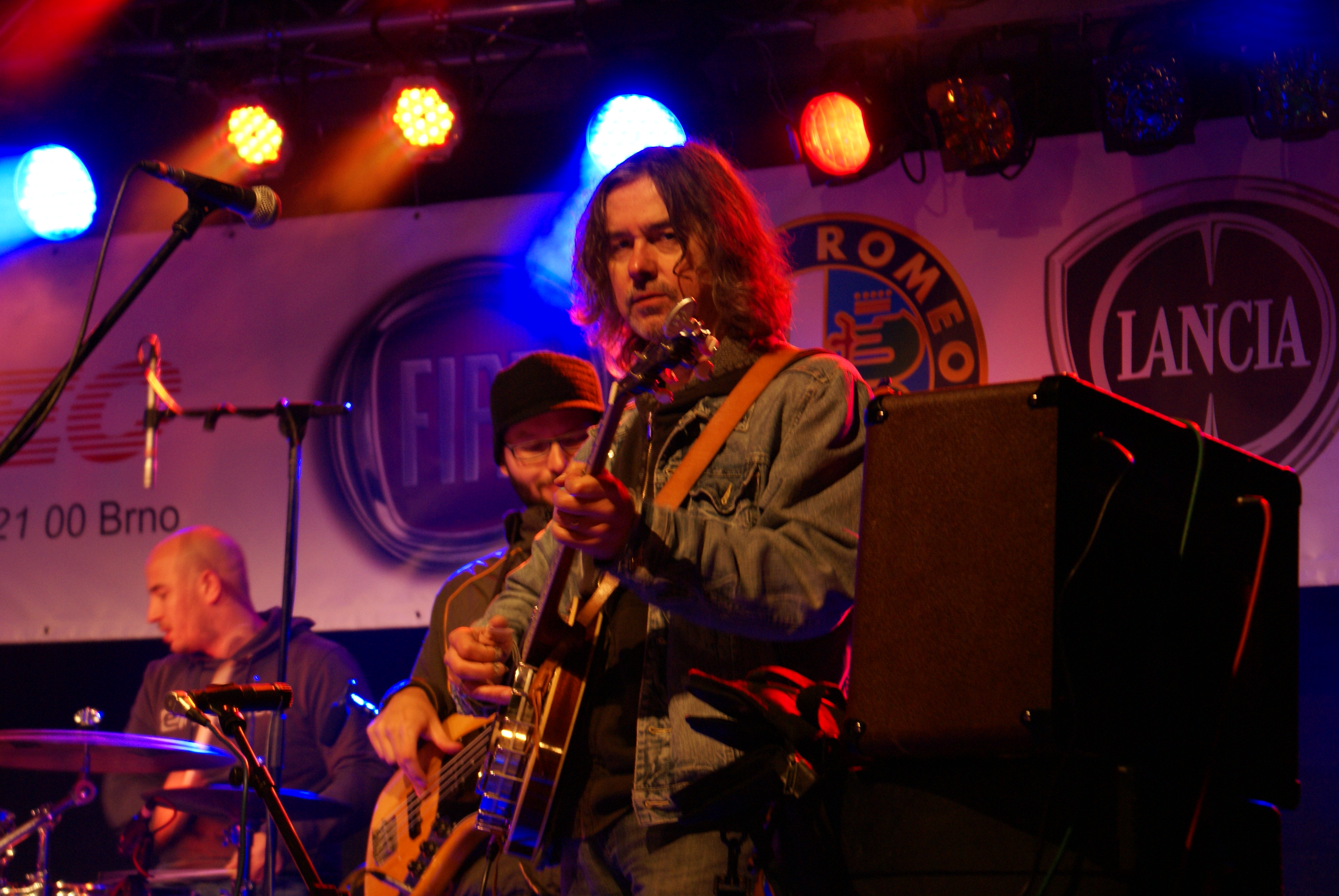
 Lubos Malina. Photo

Lubos Malina. Photo

 Visitors at a temporary exhibit in the Old Synagogue in Krakow, June 2011. The synagogue, devastated in WW2, was renovated in the late 1950s and became a division of the Krakow Historical Museum. Photo

Czech Radio’s English language service recently interview me, along with banjoist-multi-instrumentalist Lubos Malina, about the great “Czechgrass” band Druha Trava’s new double live CD.
You can access the interview by CLICKING HERE — and you can either stream the half hour interview or download it as an mp3.
We talk about the new CD set — one CD was recorded during the annual summer festival in the beautiful town of Telc, and the other is a compilation of performances last year with guests Peter Rowan, Charlie McCoy and Katia Garcia.
We also spoke about my role in DT’s previous CD, Shuttle to Bethlehem, which mainly features my English language translations of DT singer-songwriter-frontman Robert Krestan’s songs.
After the interview, Lubos and I stopped to visit the new museum devoted to pioneering Czech animator Karel Zeman, en route to a concert by Kris Kristofferson.
 Photo
Photo
I’m delighted to announce the publication of “Preserving Jewish Heritage in Poland,” an illustrated book marking the 10th anniversary of the Foundation for the Preservation of Jewish Heritage in Poland — in which I have a sort of introductory essay.
The entire text of the book can be downloaded here — http://fodz.pl/download/album_fodz_www.pdf
I’m in London, well, in Richmond, just off Richmond Park… en route to Oxford tomorrow, where I’ll be taking part in a conference at the Yarnton Manor Center for Hebrew and Jewish Studies on The Place of European Jewry in the Global Jewish Community.
It is often felt that contemporary Jewish life in North America and Israel eclipses that of European Jewry, which seems mostly concerned with the security agenda and the perception that Europe is becoming more hostile to Jews. Equally, though, European Jewish society is experiencing a renaissance through immigration, new identity patterns and innovation.
The conference will investigate the political, economic and social contexts of European Jewry, the demographic and sociological data, and the extent to which Jewish life in Europe is indeed threatened and/or experiencing a renaissance. The data will focus on the four communities in Europe that comprise 80% of European Jews

By Ruth Ellen Gruber
(This post also appears on my En Route blog for the Los Angeles Jewish Journal)
I had the pleasure and privilege Sunday of giving a presentation about the Jewish Heritage Europe web site project in Florence, in one of the city’s most prestigious and spectacular venues — the Salone dei Cinquecento of the Palazzo Vecchio, the city hall of Florence, a massive building with a distinctive tower that was originally built at the turn of the 13th and 14th centuries.
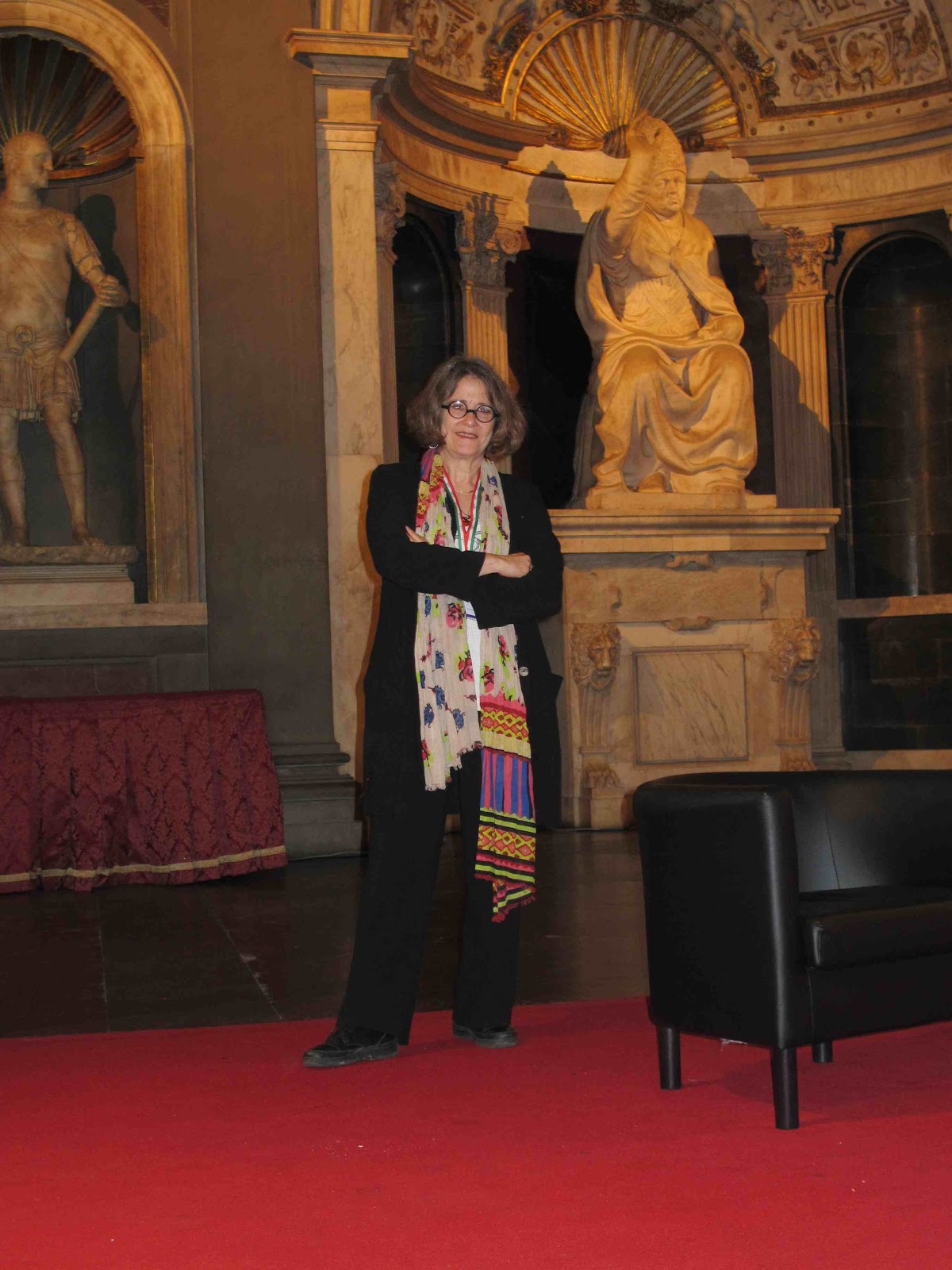
With Pope Leo X…Photo: Angelo Pontecorboli
I was part of a five-person panel speaking on various aspects of “Developing Jewish Cultural Heritage in Europe.” Our round-table was part of a huge, weeklong biennale on Cultural and “Landscape” Heritage sponsored by the Fondazione Florens. Other people on the panel included Giuseppe Burschtein, an IT specialist and Jewish heritage activist in Florence; Renzo Funaro, an architect who heads the “Opera del Tempio” project of restoration and promotion of Jewish heritage in Florence and elsewhere in Tuscany; Dora Liscia Bemporad, the director of the Jewish Museum in Florence; and Annie Sacerdoti, a pioneer of Jewish heritage documentation and activism in Italy and one of the spearheads of the European Day of Jewish Culture.
The moderator of our panel was the journalist Wlodek Goldkorn — who pointed out at the start of the event that this session was probably the first time that a Jewish program (other than a commemorative event) had taken place in the magnificent hall, a grandly huge space dating from 1494, richly decorated with a gorgeous painted ceiling, sculptures and paintings from the 16th century.

View from the Podium
We had a pretty good crowd — and nobody left in the middle! Given the mix of people on our panel, presentations included both local and Europe-wide issues — and none of us had more than 10 minutes or so to speak.
For my talk, I had an internet connection projected on two immense screens. I presented Jewish Heritage Europe as a tool that is already functional, attracting 4,000-5,000 people a month. I took the audience on a tour of the site, describing both the static content for 48 countries — and also the dynamic content — the newsfeed, calendar, and the In Focus section.
I had wanted to highlight some other web sites that bring Jewish heritage online — such as Judaica Europeana and Virtual Shtetl. But, alas, there wasn’t time.
You will just have to go to all those web sites and explore!

